
Since September 1, 2026, electronic invoicing has become mandatory in France for transactions between businesses. This reform, driven by the Ministry of Economy, is not just an administrative constraint. It directly addresses the issue of the carbon footprint of documentary flows, a factor often overlooked in companies’ environmental assessments.
End of the free public portal: what the reform changes for supplier invoices
A structural element distinguishes the current reform from initial projects. The overhaul carried out in the fall of 2024 confirmed the disappearance of the free public portal for the issuance and receipt of B2B electronic invoices. All invoices now go through approved private platforms or software connected to them.
This architecture has concrete consequences. The choice of platform determines the location of the data, the type of data center used, and thus the energy consumption associated with the digital processing of invoices. A company undertaking a supplier invoice dematerialization project must integrate this parameter from the selection of its service provider.
For SMEs that relied on a free state tool, dependence on private operators also raises an economic question. The subscription cost to an approved platform varies depending on the volume of invoices processed, and pricing structures are not standardized.
Carbon footprint of paper invoices: beyond the weight of paper
Existing articles on the subject mention paper consumption per employee, generally estimated between 70 and 85 kg per year. This figure, as telling as it is, only covers part of the problem.
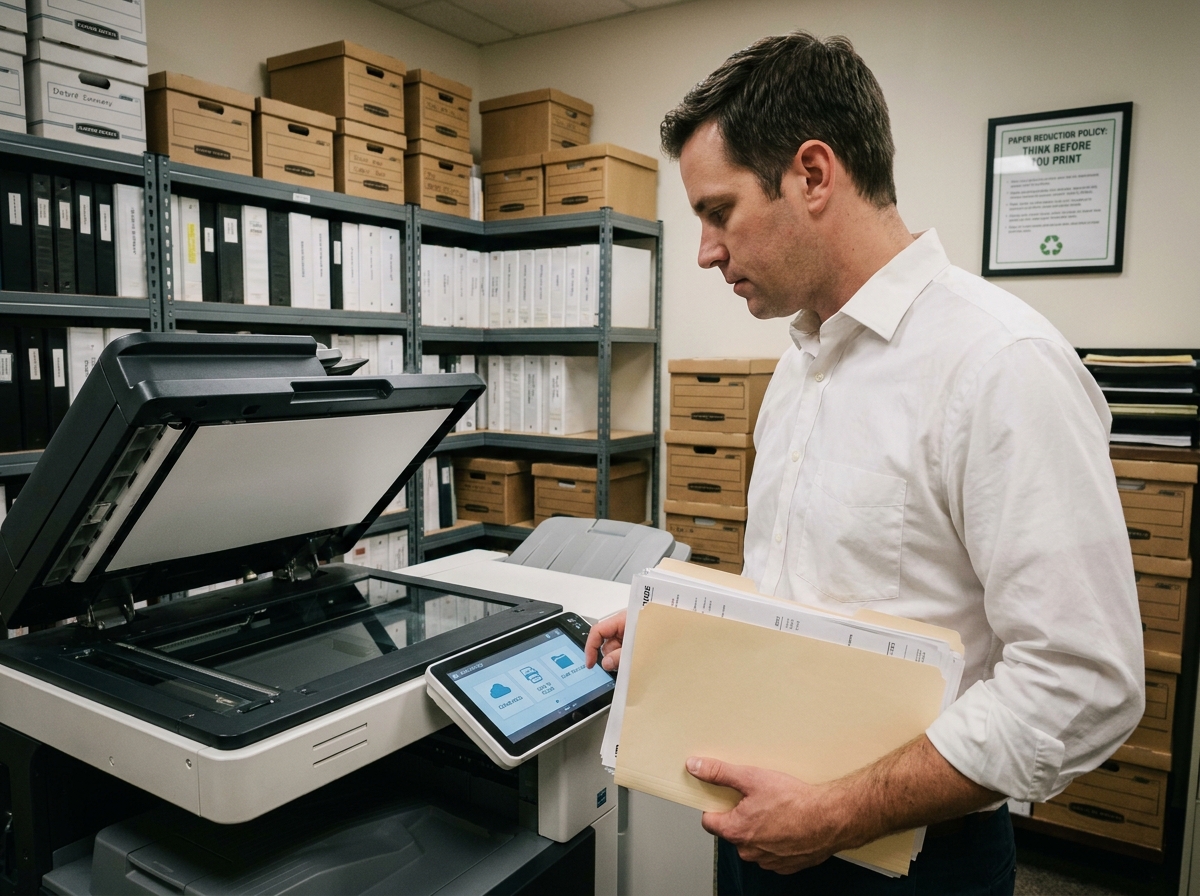
The complete life cycle of a paper invoice includes several emission sources that are rarely aggregated:
- The manufacturing of the paper itself, which requires considerable water volumes and relies on energy-intensive processes (bleaching, drying, calendering).
- Printing, with cartridges containing compounds derived from crude oil, some of which pose health risks according to the National Agency for Food Safety.
- Postal delivery, which generates transport emissions proportional to the geographical dispersion of suppliers.
- Physical storage in archives, which occupies heated, lit, and sometimes air-conditioned square meters for years.
Eliminating paper invoices does not eliminate all footprints. However, digital shifts the carbon balance to servers and networks, a factor whose impact heavily depends on the energy mix of the country where the data is hosted.
Approved platforms and data hosting: an environmental blind spot
The reform requires transitioning through partner dematerialization platforms (PDP). Their proliferation creates an ecosystem where each operator makes its own infrastructure choices.
Some platforms host their data on servers located in France, where the electrical mix relies heavily on nuclear and renewable energies. Others use data centers located in countries where electricity production is more carbon-intensive. The company that chooses its platform also chooses its digital footprint.
Criteria to check before selecting a platform
Few comparisons incorporate the environmental dimension in evaluating PDPs. Field feedback varies on this point: some platforms communicate about the location of their servers, while others remain opaque.
Three elements deserve examination:
- The geographical location of data centers and the associated energy mix.
- The data retention policy (duration, redundancy, number of copies), which directly influences storage volume and thus electricity consumption.
- The existence of a carbon reporting specific to the platform, even if simplified.
The available data does not allow for concluding that one platform is systematically more virtuous than another. The market is recent, and specific environmental labels for PDPs do not yet exist.
Tolerance phase in 2026: a risk of delay for climate commitments
The Ministry of Economy has announced a tolerance phase on sanctions for the rest of 2026. Companies that are not yet ready to issue or receive electronic invoices via an approved platform will not be immediately sanctioned.
This additional delay, understandable from an operational standpoint, has a side effect. It prolongs the coexistence of paper and digital flows within the same company. This hybrid period is the worst configuration from an environmental perspective: paper costs persist while the digital infrastructure is already active.
For a company committed to reducing its emissions, every month of dual flow increases the carbon footprint of the invoicing process. The environmental gain from dematerialization only materializes fully when paper effectively disappears from the chain.
Carbon reporting and invoices: a link still poorly formalized
Companies’ carbon assessments rarely include a dedicated item for documentary flows. Emissions related to paper invoicing are buried in broader categories (office supplies, transport, energy for premises). Dematerialization offers an indirect advantage: it makes the process measurable. The volume of invoices processed, the number of server connections, the size of stored files can feed into a structured environmental reporting.
Switching to digital makes documentary emissions traceable, which is a prerequisite for methodically reducing them.
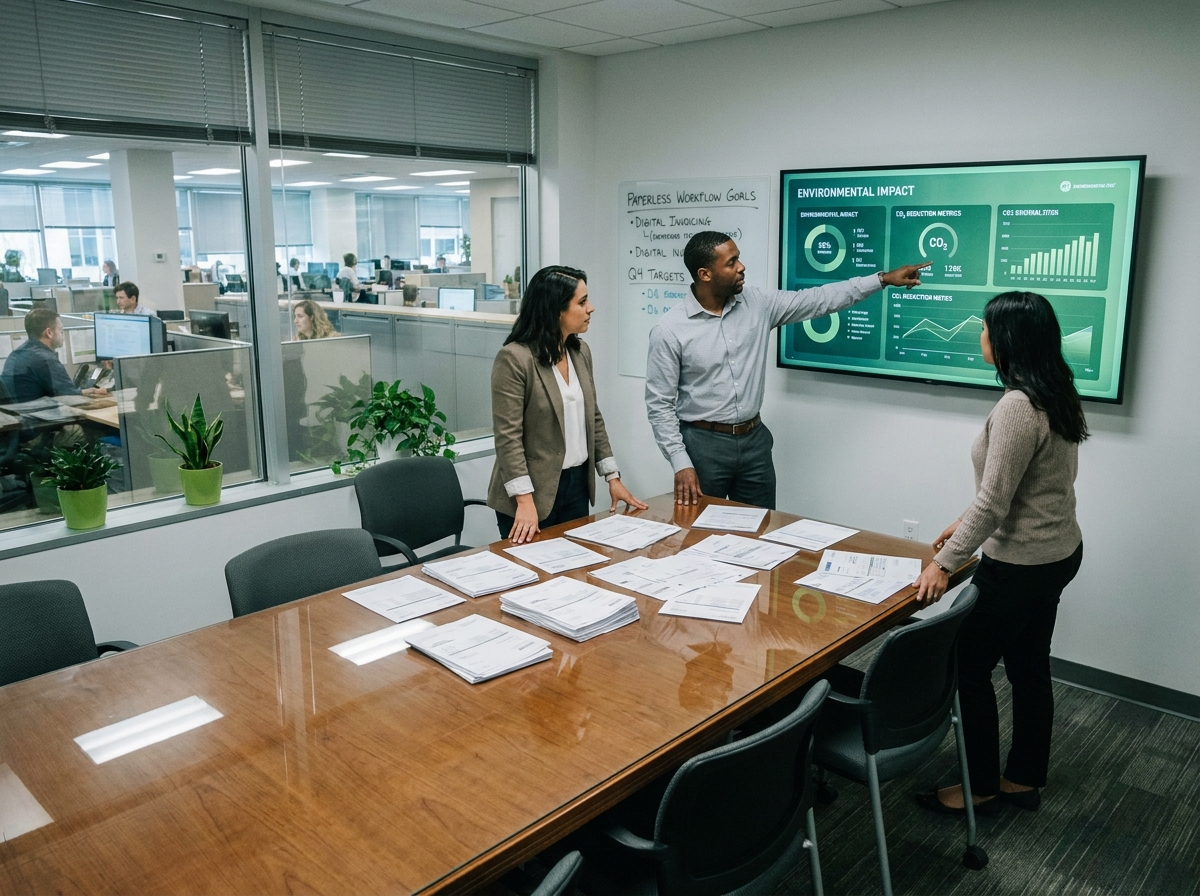
The elimination of paper supplier invoices is not a symbolic gesture. It is a measurable lever for reducing emissions, provided that digital is not considered neutral by default. The choice of platform, the location of servers, the speed of complete transition: every parameter counts in the final balance.